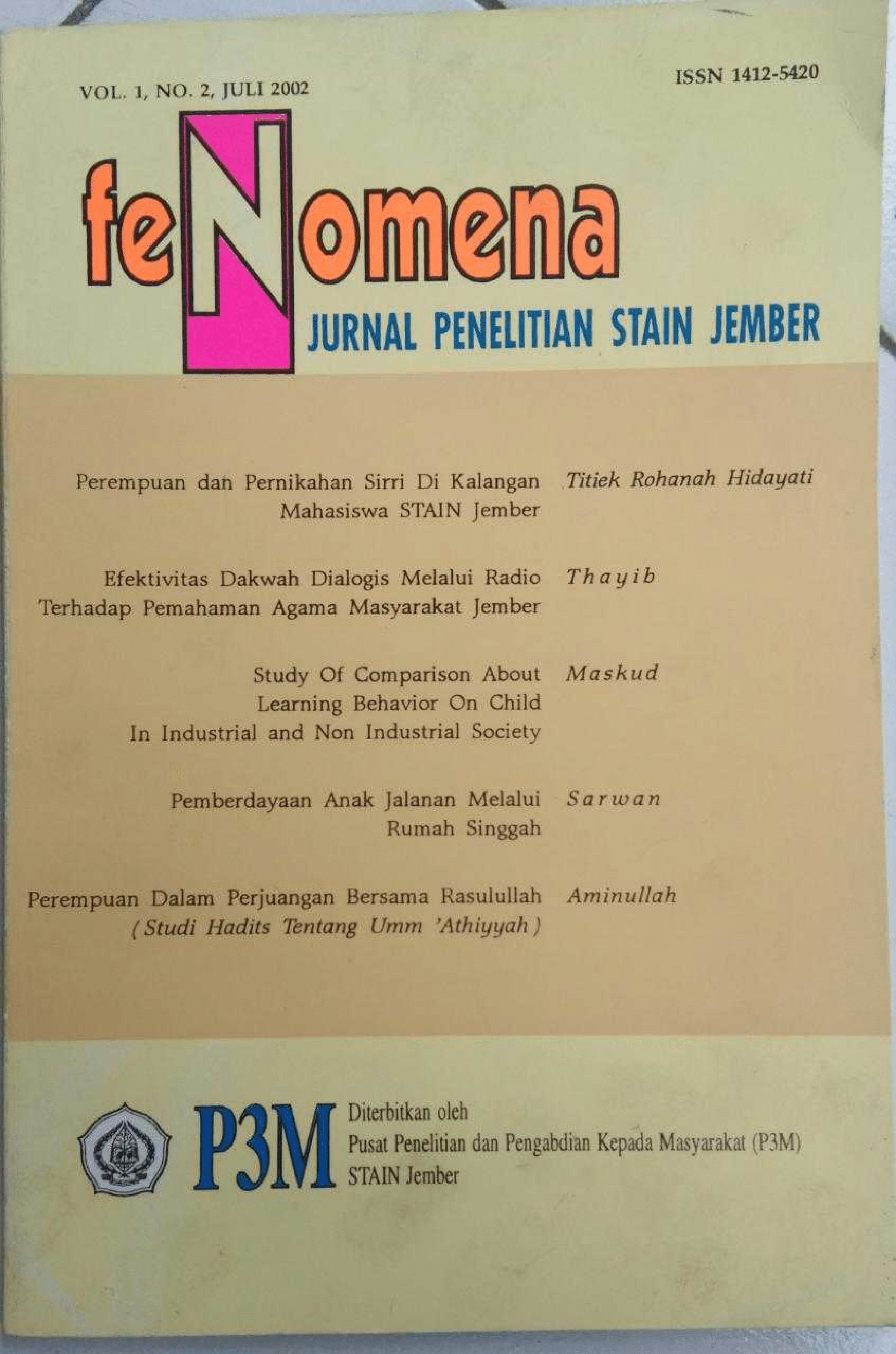
Study of Comparison about Learning Behavior on Children in Industrial and Non-Industrial Society
DOI:
https://doi.org/10.35719/fenomena.v1i2.308Keywords:
Learning behavior, Social structure, Industrial vs non-industrial society, Perilaku belajar, Struktur sosial, Masyarakat industri vs non-industriAbstract
The critical issue addressed in this study is how differing social structures—industrial versus non-industrial—shape children’s learning behavior during their developmental years. Grounded in ecological and socio-psychological theories, this research assumes that environmental conditions, social norms, and economic activities significantly influence behavioral patterns. The study aims to compare learning behaviors between children raised in an industrial setting (Cilegon) and those in a non-industrial setting (Serang). Using a cross-sectional survey with systematic observation, data were collected from 201 adolescents aged 13–16 years attending accredited public or local schools. Statistical analysis using contingency tests revealed that children in the industrial society demonstrated stronger tendencies toward competitive, materialistic, and goal-oriented behaviors, along with more developed defense mechanisms to cope with environmental pressure. In contrast, children in the non-industrial society exhibited more intuitive, cooperative, and tradition-bound learning patterns, with greater openness to feedback from failure. The study concludes that industrial environments foster achievement-driven behavior and psychological defense strategies, while non-industrial settings encourage realism and reflective learning. Recommendations include integrating socio-emotional learning tailored to local ecological contexts and conducting further cross-cultural longitudinal research.
Isu krusial yang diangkat dalam penelitian ini adalah bagaimana perbedaan struktur sosial masyarakat industri dan non-industri membentuk perilaku belajar anak selama masa perkembangan. Berlandaskan teori ekologis dan sosio-psikologis, penelitian ini berasumsi bahwa kondisi lingkungan, norma sosial, dan aktivitas ekonomi sangat memengaruhi pola perilaku. Tujuan penelitian adalah membandingkan perilaku belajar antara anak yang dibesarkan di lingkungan industri (Cilegon) dan non-industri (Serang). Metode yang digunakan adalah survei cross-sectional dengan observasi sistematis terhadap 201 remaja usia 13–16 tahun yang bersekolah di sekolah negeri atau swasta terakreditasi. Hasil analisis statistik menunjukkan bahwa anak di masyarakat industri cenderung lebih kompetitif, materialistis, dan berorientasi pada pencapaian, serta mengembangkan mekanisme pertahanan diri terhadap tekanan lingkungan. Sebaliknya, anak di masyarakat non-industri menunjukkan pola belajar yang lebih intuitif, kooperatif, dan terikat tradisi, serta lebih terbuka terhadap umpan balik dari kegagalan. Kesimpulannya, lingkungan industri mendorong perilaku berbasis pencapaian dan strategi defensif, sementara lingkungan non-industri mendukung realisme dan pembelajaran reflektif. Rekomendasi penelitian ini adalah perlunya integrasi pembelajaran sosial-emosional berbasis konteks ekologis lokal serta studi longitudinal lintas budaya lebih lanjut.
Downloads
References
Black, J.A., Champion, D.J., 1976. Methods and issues in social Research, Second Edition, New York: Wiley & Son.
Denux, K., and Wrightsman, L.S., 1988. Social Psychology. California: Brooks/Cole Publishing Company Pacific Grove.
Emmy, E.W., 1979. Cross Culture Child Development, California: A View From the Planet Earth Brook/Cole Publishing by Wadsworth, Inc., Belmont.
Hurlock, E.B., 1980. Developmental Psychology: A Live Span Approach, 5th ed., New Delhi: Tata McGraw Hill Inc.
Hurlock, E.B., 1978. Child Development, 6th ed., New York: Mcgraw-Hill.
Nourousis, M.J., 1991. SPSS, 4+ Program. Get Serious.
Portinga, Y., 1991. Cross Culture Psychology, Third Edition, New York: John Wiley & Sons.
Steinberg, L. 1993. Adolescence. International Edition. 3th Ed., New York USA Mcgraw Hill Inc.
Touliatos, J. & Compton, N.H., 1983. Approaches to Child Study, Minneapolis Minnesota: Burgess Publishing Company.
Zimbardo, P.G. 1979. Psychology and Live. Tenth Edition, Illinois: Scot Foresman & Company Glenview.
Downloads
Published
Issue
Section
License
Copyright (c) 2002 Maskud Maskud

This work is licensed under a Creative Commons Attribution-NonCommercial 4.0 International License.